
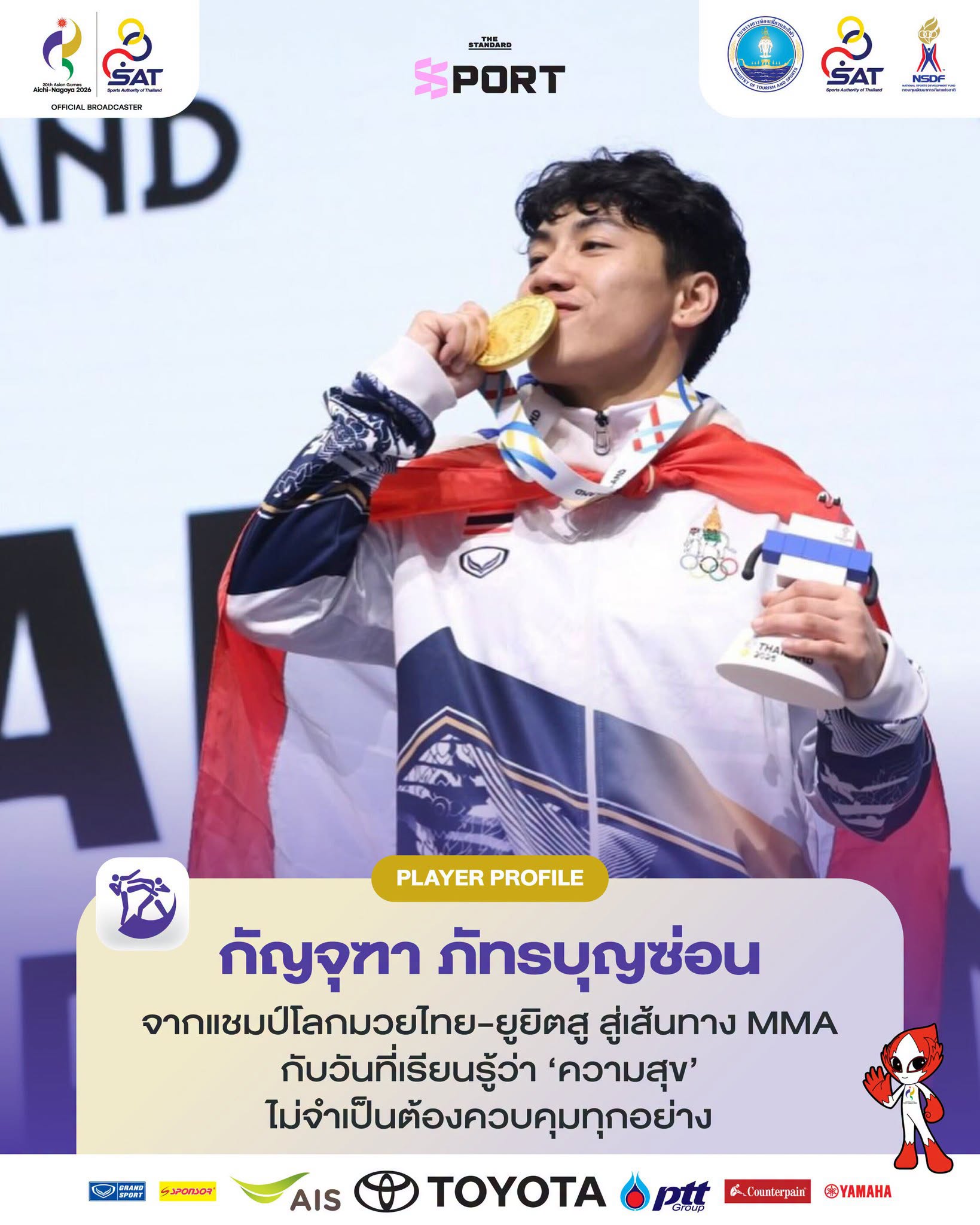
Kanjuta Phatrunson: From Muay Thai–Jiu-Jitsu World Champion to the MMA Path and the Day She Learned That ‘Happiness’ Doesn’t Have to Mean Controlling Everything
18 Sep 2026 · association · TAMMA · via TAMMA

Ringkasan
Kanjuta Phatrunson: From Muay Thai–Jiu-Jitsu World Champion to the MMA Path and the Day She Learned That ‘Happiness’ Doesn’t Have to Mean Controlling Everything. More than 9 years on the fighting path of Amp–Kanjuta Phatrunson have been filled with both success and tests—from professional Muay Thai fighter to three-time Jiu-Jitsu world champion…
Kapsyen
Kanjuta Phatrunson: From Muay Thai–Jiu-Jitsu World Champion to the MMA Path and the Day She Learned That ‘Happiness’ Doesn’t Have to Mean Controlling Everything

More than 9 years on the fighting path of Amp–Kanjuta Phatrunson have been filled with both success and tests—from professional Muay Thai fighter to three-time Jiu-Jitsu world champion. But beneath those victories, what she was doing felt more like ‘duty’ than what her heart loved.

Until one day, Amp decided to set aside both status and success, willing to drop her ego to become a ‘beginner’ again on the MMA path. From the first day of training until she was vomiting from the intensity, today she has become a world champion in the arena of her dreams and a new star—the medal hope of the Thai squad in the women’s 54 kg class at the 20th Asian Games.

Yet what she discovered on the MMA fighter’s path was not only victory, but lessons that taught her to let go, accept uncertainty, and understand that the most important fight may not be beating anyone else, but being herself and doing what she loves.

🥋A 9-year path until duty and love finally met

Throughout more than 9 years as an athlete, Amp can say without hesitation that life in the ring has been ‘tough’ more than once.

From a child who loved sports from the start, she began her fighting path with Muay Thai, because at that time MMA was not widely known in Thailand. She then stepped up to become a professional Muay Thai fighter and won the World Muay Thai Council championship.

“Amp has loved sports from the beginning and loved MMA very much, but back then it was not popular in Thailand, so she chose to do Muay Thai. One day she became a professional Muay Thai fighter, competed, and won the World Muay Thai Council championship.”

Yet the strength that took her to the top became a limitation when Amp struggled to find opponents at 100 pounds. The Muay Thai path had to stop, and she turned to a new chapter as a Jiu-Jitsu athlete on the Thai national team.

From there came a new international journey, with success reaching three world championships.
Amp’s name carried both titles and medals, but looking back, she felt that what she had done all along was ‘duty’ more than what her heart wanted.

She compared life in that period to someone who had to sit working in front of a computer every day, when what she really wanted to do was draw.

Duty is what we must be responsible for; love is what we want to do—and for Amp, what was missing was the day those two would become the same thing.

Until one day MMA grew more popular in Thailand, sports associations were established systematically, and opportunities that once seemed far away began to come toward her.
This time Amp did not have to choose again.

She was able to return to doing what she loved, while fulfilling her role as an athlete at the same time.

“It was such a perfect fit. We could say we were ready to devote our life to this sport. From the day I started as a boxer until the day I became an MMA athlete, it was like doing what we loved alongside duty in the ring. Everything was good—we could support ourselves from what we truly enjoyed.”

🥋Dropping ego to truly start again

Even though she returned to doing what she loved, the MMA path did not begin beautifully.
Success from Muay Thai and Jiu-Jitsu did not make everything easier. When she stepped into MMA seriously, Amp found that the competition format, match duration, and training methods were all different.

“Once I really started playing seriously, I felt it was very different—the competition format, match duration, training methods—it was a completely different matter.”

“The first day I came back to train I was vomiting. It was very hard, hard enough that I started asking myself whether I should give up this intention, because it felt like I couldn’t go on.”

But the first competition became the answer.

Even though she was not fully ready and was so exhausted she almost cried, Amp still won a silver medal.
“I told myself that when we weren’t ready for anything at all we still got a silver medal, and ahead there isn’t just this one match. Plus the people around me kept encouraging me, which made me get up and keep fighting.”

That silver medal made Amp decide to push forward, but what had to change was not only her body—it was the identity she had clung to all along.

“We were a Jiu-Jitsu world champion level—so why couldn’t we do MMA?”

The answer was not trying to become the same world champion again, but being willing to leave that behind.

“You have to drop all ego, including the feelings, everything, and start counting from one again.”
When she no longer had to carry her old status into the ring, Amp opened space for herself to truly learn MMA. From that fresh start, she gradually developed, won her first gold medal, and eventually reached the position of MMA world champion.

That lesson changed the way she viewed competition completely.

Amp did not step on stage thinking she had to win every time, but wanting to bring out what she had trained and show it at its best. And when she stopped pressuring herself to win every time, she found that the hardest opponent might not be across the stage, but in her own mind.

🥋When victory is not life’s only goal

From Muay Thai to Jiu-Jitsu, and from Jiu-Jitsu to MMA, Amp’s path did not teach only fighting skills—it gradually changed how she saw the world and herself at the same time.

“Amp sees MMA as having to read the game all the time. There is no way to know what form the opponent will come in. When the situation changes, the athlete has to change too—both attack and defense—and solve problems on the spot, so you have to use your mind alongside physical strength.”

“In life it’s the same—from a hot-tempered person to someone calmer and more thoughtful before doing anything.”

Throughout the path, Amp had to face judgment, expectations, and memories from people around her, including questions about gender identity that had been with her since childhood.

These may once have been wounds, but from another angle they also taught her what to keep and what to put down.

MMA thus became a space where Amp did not have to prove herself with words.

In the ring there is no definition of which gender should be stronger than another—there is only ability, training, and the identity each person chooses to show.

“Whether woman or man, whatever gender, everyone has potential within themselves.”

From the day she once viewed sport through the word ‘duty’ to today, MMA has become a space where Amp found love, dreams, and her own identity.

Looking back, her journey was not only titles or medals, but learning to fall, accept flaws, start again, and let go of what cannot be controlled.

Because in the end, fighting may not have to mean beating anyone.

Sometimes it may simply be being yourself, doing what you love, and when life knocks you down, still being ready to get up and fight again.

That alone is enough.

🥋Key opponents

Although Kanjuta Phatrunson has already won world championships and an Asian championship, these Asian Games are another test—because beyond facing skilled opponents, she must compete amid the pressure of a continental sports festival.

One opponent to watch is Tomoe Katayama from Japan, host of these Asian Games, who besides having the advantage of home crowd support is also an opponent Amp admits she fears most.

The main reason is that the two have never faced each other before in an international tournament, even though Amp has studied the host fighter’s skills through competition tapes.

Another opponent not to underestimate is Vallensia Fahira from Indonesia. Although the Thai fighter once beat her by TKO in the SEA Games 2025 final last December, meeting again on the Asian Games stage cannot be taken lightly either.

🥋Where MMA competes and how many gold medals are at stake

MMA, or mixed martial arts, at the 20th Asian Games awards 6 gold medals, contested between 20–22 September at Nagoya City Inae Sports Center, Higashi Ward, Nagoya City, Aichi Prefecture.

The Mixed Martial Arts Association of Thailand sent 2 athletes: Sakdith Chanthahom in the men’s 71 kg class and Kanjuta Phatrunson in the women’s 54 kg class. The association set a goal to win medals from this competition, and both will be Thai representatives stepping onto the field hoping to make history for MMA at the Asian Games for the first time.
.
#TheStandardSport #มากกว่ามหกรรมกีฬา #AllinAsianGames #AichiNagoya2026 #AsianGames2026
Tiada transkrip untuk item ini.